

I’ve worked with a lot of fractional CMOs, and the pattern is pretty consistent. CMOs are never short on ideas: they’re short on time, structure, and a team that can actually execute what’s in their head.
So they turn to AI, like everyone else. And for a minute, it feels like a win. Content gets produced faster. But then, they're not seeing results. You start putting a lot more stuff out there, but not a lot more results.
AI promised speed, and it delivered. But speed without structure = noise. Google is already cracking down on low-value, mass-produced content that doesn’t actually help anyone.
It's less about the most you can make, and more about making the most out of less. Knowing who your buyer is, what motivates them, what questions they have, and what they already know.
The fractional CMOs who are winning right now aren’t just using AI to produce more content. They’re using AI to streamline execution, improve targeting, and tie their marketing back to real outcomes.
Why Most AI-Driven Marketing Strategies Fall Apart
AI makes it really easy to do more. More blogs, more emails, more LinkedIn posts. But as I've already hit on, "more" isn't really "better." When you rely on AI tools to generate content without a strategy behind it, you end up with:
- Thin, over-optimized content: It’s written to rank or check a box, not to help someone make a decision. You can tell it was generated with the intent of getting scraped, not actually providing value. So can Google.
- Content that doesn’t speak to your buyer: It’s not aligned to a specific persona or where they are in the buying journey. It exists, but it doesn’t move anyone forward because it's not helpful.
- Campaigns that launch…and then stall: You spin something up quickly with AI, push it live, and then move on. No iteration based on data. No connection to future efforts.
- No momentum from what’s already working: Wins don’t compound. Every new effort starts from scratch instead of building on past performance.
- The same underlying data problems: AI doesn’t fix messy CRM architecture. If your data is unreliable, your targeting and reporting will be too.
- Reporting that doesn’t tell a clear story: Numbers exist, but they don’t connect, or your customer doesn't understand what they mean. It’s hard to prove what’s actually driving results.
- Confusion around AI itself: Some clients hesitate to use AI at all. Others expect it to replace people. You’re stuck managing expectations on both sides.
And that’s where most AI-driven marketing strategies fall apart. You can have great tools, good ideas, and solid goals. But without a system behind what you're doing, you're just creating noise.
Related Content: What AI Search Actually Rewards (Spoiler: It’s Not AI Content)
What Winning Fractional CMOs Do Differently
As a fCMO, you have experience, perspectives, and taste that AI doesn't. And that's exactly how you can provide value to your customers and stand out from what other CMOs are doing.
Anyone can open ChatGPT and generate a blog post. But that low-effort content generation is starting to fail.
Your value as a fractional CMO is the structure behind a successful marketing program. The strategy, the prioritization, and the ability to connect marketing to actual business outcomes.
The fractional CMOs who are winning right now understand something most don't: AI is not the strategy-creator, it’s the accelerator.
Most marketing programs are still operating in campaign mode. Launch something, promote it, move on to the next thing. Use AI to make that process faster. That approach worked when channels were simpler and linear – it just doesn’t work anymore. Customers are engaging differently. So we as marketers need to change our approach, too.
The Loop Marketing Approach (And Why It Works)
Now that I've established the challenges fractional CMOs are facing, let's move into the fun part: how you can actually start building a strategic framework.
Loop Marketing is a system that connects content, campaigns, data, and optimization into a continuous cycle that improves performance over time. It’s not just a one-off campaign or a content calendar that lives in a spreadsheet: it’s an actual system. And it's one that fractional CMOs can create (or create in partnership with an agency) that they can then offer to their clients, to set them apart from what every other fractional CMO is doing right now.
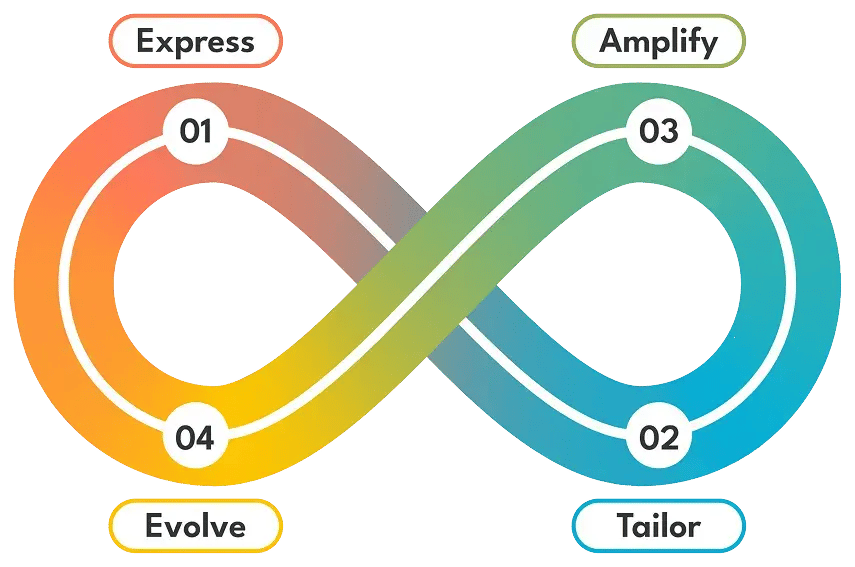
Here’s how it works:
- You start with Express: capturing insights, ideas, and messaging based on real customer questions and business goals. This is where AI helps you think faster and spot patterns. You can use it to analyze customer questions, surface content opportunities, and see what type of content your target audience is looking for. A note: trust...but verify for any research query in an AI tool.
- You move onto Tailor: refining that messaging for your audience, your channels, and where someone is in their buying journey. Once you have the core idea, AI helps you adapt it. Different audiences, different channels, different stages of the buying journey.
- Next, you Amplify: distribute content across the right channels using AI and automation to increase reach and consistency. AI helps you extend the life of your content by supporting distribution, timing, and channel selection.
- Then, Evolve: measure what's working, learn from it, and use it to improve the next cycle. AI helps you understand what’s working, what’s not, and what to do next so you’re not guessing or relying on gut feel.
Lather, rinse, repeat. But instead of just repeating the same thing over and over again, you're using real data, the speed of AI, and your expertise to continuously refine what you're doing. This also makes the strategy much more future-proof: you're not just chasing a trend that's working now, you're continuously improving and adapting.
The focus shifts from producing as much content as possible to producing the right content. This is where you can use AI tools to ramp up production, but empower it with real data so you're not just delivering a thin, low-value message: you're actually creating the exact, contextually relevant information a specific target audience wants, where they are. That means better quality leads.
Related Content: What is Loop Marketing? Marketing in the AI Era
How AI Tools Fit Into Loop Marketing
As I've said at length: AI isn’t the strategy. It’s the support system. When it’s used inside a structured approach like Loop Marketing, it starts to do what everyone hoped it would do in the first place: save time, improve accuracy, and help you scale what’s already working.
The specific tools I recommend are simple: ChatGPT, HubSpot’s AI tools, Gemini, and Claude.
Everyone has their preferences, but the key is how they handle your data.
If you’re working with sensitive client information, you need tools that keep that data secure. That’s why HubSpot’s AI tools and Gemini are strong options. They’re built to work with your data in a controlled environment. Additionally, HubSpot's AI tools can build agents that work on your behalf, so you don't have to repeat efforts.
With tools like ChatGPT and Claude, you just need to be more intentional. The free versions may use your inputs for training, which can be a risk. If you’re using them, stick to paid plans and turn off data sharing.
At the end of the day, the specific tool matters less than how you use it, and how securely it handles data.
Final Thoughts
There’s a lot of noise right now around AI replacing marketers, but that’s not what’s happening. AI is replacing some of the manual execution of tasks . It's not replacing the experience and perspective marketers bring.
If anything, it’s increasing the need for experienced marketers who can think high-level and who can put guardrails and automations in place to follow a strategy.
Fractional CMOs are in a stronger position than ever because the gap is clearer. AI can produce, but it can’t prioritize, connect systems, or align marketing with business outcomes. That’s your role.
And when you pair that with the Loop Marketing framework, AI becomes a multiplier. That’s how you stop creating noise and start building something that actually drives results.
Loop Marketing Services
Loop Marketing is the next evolution in digital strategy, and brands that adapt early will see the biggest wins. BizzyWeb is a Minneapolis-based digital marketing and web design agency that helps companies get the high-quality leads they need to grow and thrive. We are also a HubSpot Diamond Partner and we offer full-service HubSpot onboarding, clean-up, and strategy for all hubs. This unique combination of experience gives us a unique perspective and experience with all the tactical pieces that form together to create Loop Marketing.
Every plan is tailored to your brand, your goals, and your audience. No two strategies are the same.
BizzyWeb is a Minneapolis-based digital marketing and web design agency that helps companies get the high-quality leads they need to grow and thrive. Our tactics include inbound marketing, SEO, advertising, web design, content creation and sales automation. We are an accredited HubSpot Diamond Partner and we offer full-service HubSpot onboarding, enablement and strategy for new and current users.